
Finding termites in a house that is already built can be stressful. You may notice mud lines on a wall, a door frame that sounds hollow, or wooden cabinets that crumble when you touch them. The good news is that you can still protect an existing building. Post-construction termite treatment, commonly done with the drill-fill-seal method, creates a barrier around and beneath your home without demolishing floors or walls.
This guide explains how post-construction termite treatment works, what happens on treatment day, how to prepare, and how to keep termites from coming back.
What Is Post-Construction Termite Treatment?
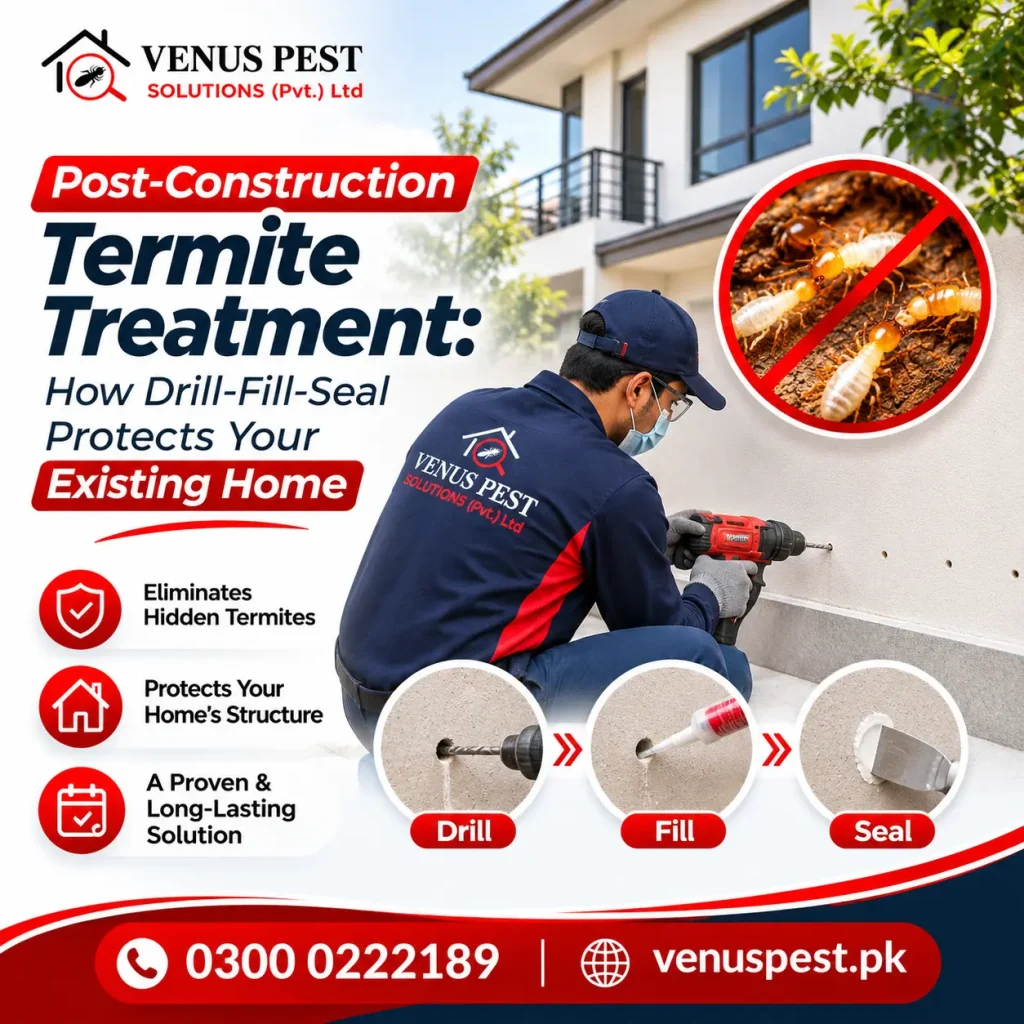
Post-construction termite treatment is an anti-termite treatment for buildings that are already complete. Because floors cover the soil under the building, technicians drill small holes at planned points, inject an approved termiticide into the soil and wall joints, and then seal the holes. The goal is to create a continuous chemical barrier that blocks subterranean termites from reaching the structure, while also treating active infestation in woodwork.
When Do You Need Post-Construction Termite Treatment?
- Mud tubes on walls, floors, skirting or around door frames
- Hollow-sounding or soft wood in doors, frames, cabinets or furniture
- Discarded wings near windows, doors or lights, especially after rain
- Small holes, powdery residue or peeling paint along walls
- Termite damage found during renovation or flooring work
- You bought or rented a property without any record of termite proofing
For a detailed list of warning signs, see 7 signs your home needs termite treatment and our guide on hidden termite detection.
How the Drill-Fill-Seal Method Works
Step 1: Inspection
A trained technician inspects the property to find active termite areas, entry points, moisture problems and the type of floors and walls. This decides where the drilling points will go and how much treatment your property needs.
Step 2: Drilling
The technician drills small holes at regular intervals along the junction of floors and walls, around door frames, near plumbing lines and along the external perimeter. The holes reach the soil or the gap beneath the floor.
Step 3: Filling (Chemical Injection)
The team injects an approved termiticide into each hole under controlled pressure. The chemical spreads into the soil and joints, forming a treated zone that termites cannot cross safely.
Step 4: Sealing
The team then seals each hole with cement or a matching filler so the floor stays neat and the treatment stays in place.
Step 5: Woodwork and Spot Treatment
The technician treats infested doors, frames, cabinets and furniture directly. Badly damaged wood may need repair or replacement, which your technician will point out.
Step 6: Follow-Up
Follow-up inspections help confirm that termite activity has stopped and that the barrier is working.
Benefits of Post-Construction Termite Treatment
- Protects an existing home without breaking floors or walls
- Treats active termites as well as future entry points
- Helps save expensive doors, cabinets, wardrobes and wooden flooring
- Suitable for houses, apartments, offices, shops, schools and warehouses
- Holes are small and sealed after treatment
How Long Does the Treatment Take?
The time depends on the size of the property, the number of drilling points and the level of infestation. A typical house is often completed within a day, while larger homes and commercial buildings may need more time. Your technician will give you an estimate after the inspection.
How to Prepare Your Home Before Treatment
- Move furniture and stored items away from walls where drilling will take place.
- Empty the kitchen cabinets and wardrobes that need treatment.
- Cover or move food, utensils and children’s items.
- Keep children and pets away from the treatment area during the work.
- Tell the technician about water pipes and electrical lines inside walls or floors.
What to Do After the Treatment
- Follow the re-entry and ventilation advice given by your technician.
- Do not wash or wet-mop treated areas heavily for the period advised.
- Do not remove the sealing from drilled holes.
- Fix leaking pipes, damp walls and drainage problems, because moisture attracts termites.
- Keep wood, cardboard and debris away from walls and the ground.
- Report any new mud tubes or termite activity quickly.
For more long-term prevention tips, read how to stop termites permanently.
Post-Construction vs Pre-Construction Treatment
Pre-construction treatment goes into the soil during building work, before the builder lays the floors. Post-construction treatment is for buildings that are already finished. If you are building a new home or extension, plan for pre-construction termite proofing. If your home is already built, the drill-fill-seal method is the practical way to protect it.
Why DIY Sprays Are Not Enough
Store-bought sprays may kill the termites you can see, but the colony lives in the soil and continues to send workers into the building. Without treating the soil and entry points, the problem usually comes back. Professional treatment targets the source and the routes termites use.
Why Choose Venus Pest Solutions?
Venus Pest Solutions (Pvt.) Ltd. provides termite control and deemak control services for homes and commercial properties. Our team carries out a proper inspection, plans the drilling points for your building, uses approved products according to safety guidelines, and seals the work neatly. We also guide you on prevention so your property stays protected.
Frequently Asked Questions
1. What is post-construction termite treatment?
It is an anti-termite treatment for completed buildings. A technician drills small holes, injects an approved termiticide into the soil and joints, and then seals the holes.
2. Will drilling damage my tiles or marble floor?
The holes are small, and the team seals them after treatment. Your technician will plan drilling points to keep marks to a minimum.
3. Do I need to leave my house during treatment?
This depends on the size of the treatment and the products used. Your technician will tell you which areas to avoid and for how long.
4. Can termites come back after treatment?
A properly done treatment gives long-lasting protection, but moisture, new construction or disturbed soil can create new gaps. Regular inspections help catch problems early.
5. Is post-construction treatment suitable for apartments?
Yes. We can treat apartments, offices, shops and other buildings too. We adjust the method to suit the floor level and building structure.
6. How do I know if I need treatment?
If you see mud tubes, hollow wood, discarded wings or damaged woodwork, book an inspection so a professional can confirm the problem and suggest the right treatment.
Contact Venus Pest Solutions (Pvt.) Ltd.
Phone / WhatsApp: 0300 0222189
Address: 178, Government Officers Residence – V Block A, GOR 5, Lahore
Timings: Open 24 hours
Website: venuspest.pk
Seeing signs of termites? Book a termite inspection or contact our team today.